
business
Is the Moroccan Diaspora Being Silenced or Priced Out of Their Homeland?

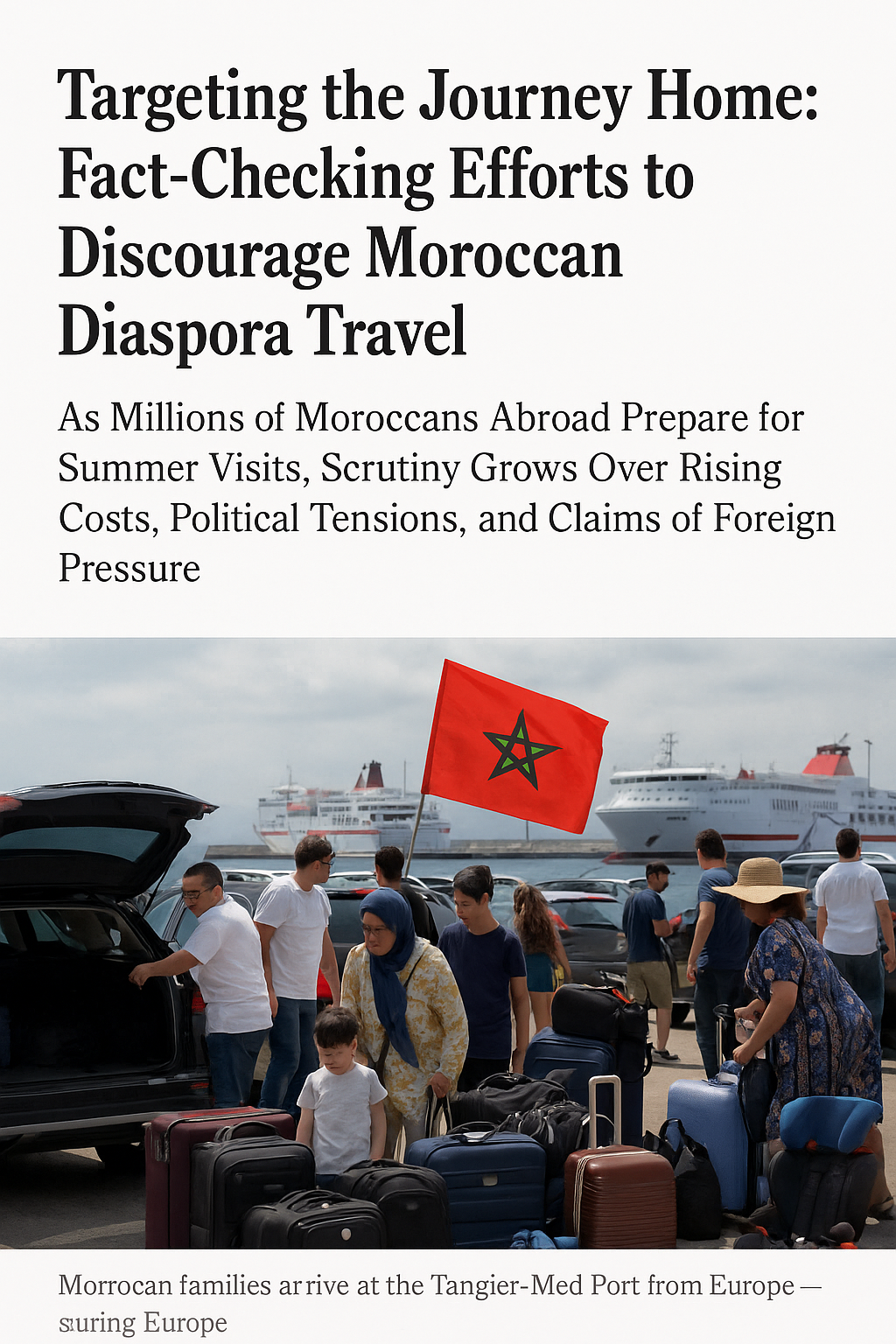
As Millions of Moroccans Abroad Prepare for Summer Visits, Scrutiny Grows Over Rising Costs, Political Tensions, and Claims of Foreign Pressure
By El Mostafa Ouchen | Senior International Correspondent
July 28, 2025 | Rabat – Paris – Madrid
Every summer, the highways of Europe hum with Moroccan license plates. Families return from Belgium, France, the Netherlands, and beyond, carrying gifts, stories, and a longing for home. Known as Operation Marhaba, this massive transcontinental migration symbolizes more than vacation — it is a yearly reaffirmation of identity, belonging, and familial bonds.
But in 2025, murmurs have grown louder: Are there coordinated efforts by foreign actors to discourage Moroccans abroad from returning home? From soaring ticket prices and political disputes to far-right rhetoric in Europe, many in the diaspora feel unseen, if not unwelcome.
A monthslong investigation into these claims reveals a nuanced truth. While there is no credible evidence of any coordinated third-party campaign to boycott Moroccan diaspora travel, a convergence of political frictions, economic pressures, and isolated policy decisions has cast a shadow over what should be a joyful annual tradition.
A Tradition Under Pressure
Morocco’s diaspora — over 5 million strong, primarily concentrated in France, Spain, the Netherlands, and Belgium — contributes billions annually in remittances and plays a pivotal role in Morocco’s economy and diplomacy. In 2023 alone, over 3.5 million Moroccan expatriates traveled home during the summer season.
“It’s not just a visit. It’s part of our identity,” says Hafid El-Khatib, a Dutch-Moroccan father of three. “But every year, it’s getting harder — more expensive, more complicated.”
Airfare and Ferry Price Hikes: A Costly Homecoming
The most immediate challenge facing diaspora travelers is financial. Reports from Moroccan expatriates in Europe detail dramatic price increases in airfare and ferry services. Flights from Paris to Casablanca, once under €300 round trip, now frequently exceed €800 in peak season. Ferry companies like GNV and Naviera Armas are also under scrutiny for hiking prices without transparent justification.
“These aren’t luxury trips — they’re reunions with our families,” said Fatima Bensalem, a Moroccan teacher in Belgium. “When prices double in one year, it feels like we’re being priced out of our heritage.”
While no evidence suggests these price surges are politically motivated, the lack of regulation and limited competition has sparked accusations of exploitation, with some diaspora communities organizing boycott calls against specific ferry companies following customer mistreatment or safety concerns.
Political Tensions: Travel as a Diplomatic Pawn
On occasion, political disputes have directly impacted diaspora mobility. In 2021, a diplomatic spat between Rabat and Madrid saw Morocco suspend transit via Spanish ports, forcing travelers to reroute through France or Italy. The move angered Moroccan families, who endured longer travel times and higher costs.
Spain’s far-right VOX party exacerbated tensions by calling for the closure of borders to Moroccan-origin travelers, citing immigration concerns. Though never enacted, the statement ignited widespread backlash and fear.
“It’s dangerous when travel — a fundamental right — is politicized,” warned Dr. Salim Hamidi, a migration researcher in Barcelona. “Such rhetoric feeds mistrust and alienates communities.”
Similarly, France’s temporary visa restrictions on Moroccans in 2021-22, imposed due to disputes over deportation cooperation, left many Moroccan-French families stranded or delayed.
These episodes were ultimately resolved diplomatically, but they left a lasting impression — that diaspora rights can be vulnerable to foreign policy bargaining.
Security and Legal Risks: Chilling Effects on Travel
Though rare, cases of surveillance or detentions of outspoken Moroccan critics living abroad have created anxiety. Some dual nationals, particularly activists linked to the Hirak Rif movement, report self-imposed travel bans, fearing reprisal or unjust detention.
“We’re not telling people not to visit Morocco,” said Nadia Ziane, a Paris-based human rights advocate. “But they must be aware — especially those who’ve criticized the regime publicly.”
While these cases don’t reflect a systemic policy, they contribute to a climate of caution.
Welfare Restrictions and Bureaucracy: Invisible Barriers
European governments, particularly in Spain, have introduced stricter enforcement of travel-related welfare regulations. A recent case involved a jobless Moroccan-Spanish dual citizen being fined €12,000 for taking an undeclared trip to Morocco while receiving unemployment benefits.
Other countries monitor social media or passport records to verify that beneficiaries aren’t misusing their entitlements. These policies are not ethnically targeted, but disproportionately impact diaspora members, especially low-income retirees who spend extended periods in Morocco.
Are There Active Boycott Campaigns?
Contrary to some online claims, there is no verified campaign by foreign governments, NGOs, or international media calling for a general boycott of Moroccan travel.
- Some Western Sahara activists have urged tourist boycotts of Morocco over human rights issues, but these are limited in scope and rarely directed at diaspora.
- Small-scale boycotts, like that against Naviera Armas after the disappearance of a Moroccan youth on board, reflect consumer activism, not geopolitical agendas.
Morocco’s Official Response
Moroccan authorities have repeatedly stressed the importance of diaspora engagement, often stepping in to mediate or respond to crises. King Mohammed VI has personally ordered fare reductions and logistical support for Operation Marhaba. When visa restrictions arose in France, Morocco successfully negotiated their reversal.
“Our citizens abroad are not tourists — they are family,” said a spokesperson from the Ministry of Foreign Affairs. “We will always defend their rights to return.”
Conclusion: A Complex Landscape, Not a Conspiracy
Despite concerns and frustrations, the investigation reveals no coordinated third-party effort to undermine Moroccan diaspora travel. Instead, diaspora mobility is shaped by a complex mix of economic, political, and logistical factors — some temporary, others structural.
Moroccan expatriates continue to return in large numbers. But their voices — calling for fairness, dignity, and affordability — are becoming louder. As the world becomes more connected, so too must the systems that support the ties between homeland and diaspora.




Verizon announced a sweeping workforce reduction that will affect “more than” 13,000 employees — roughly 13% of its global headcount — in what CEO Dan Schulman calls the company’s largest-ever layoff. In an internal memo, Schulman says the move is intended to “simplify our operations to address the complexity and friction that slow us down and frustrate our customers.” The company also plans to cut outsourced and outside labor costs significantly. U.S.-based staff will begin receiving notifications today; employees outside the U.S. will be informed in the “coming weeks,” the Wall Street Journal reports
What Verizon says
- Reason: operational simplification and removing friction that hurts customer experience.
- Scale: “more than” 13,000 roles, about 13% of the workforce.
- Outsourcing: a significant reduction in outsourced and outside labor spending is part of the plan.
- Timing: U.S. notifications begin immediately; international notifications will follow.
Immediate impact
- Employees: tens of thousands will be affected directly or indirectly. U.S. notifications beginning today means many workers will learn their status immediately.
- Operations: Verizon says the goal is to reduce complexity and improve service — but short-term disruption to teams and projects is possible as roles are consolidated.
- Customers: Verizon frames the change as a way to speed decision-making and improve customer experience, though execution risk exists during the transition.
- Outsourced partners: vendors and contract workers can expect renegotiation or reductions.
What affected employees should do now
- Check official communications from HR and your manager for next steps and severance details.
- Ask about outplacement support (resume help, job counseling) and whether the company offers extended healthcare, COBRA assistance, or phased transitions.
- Document your work (accomplishments, repos, access) and secure personal copies of non-sensitive materials.
- File for unemployment as soon as possible where eligible and update LinkedIn and your network.
- Use company resources (employee assistance programs, career centers) and local talent services.
What managers and the company should prioritize
- Clear, compassionate communications and FAQs for affected employees.
- Fast, transparent explanation of severance, benefits continuation, and outplacement services.
- Careful workload redistribution and project continuity plans to avoid customer impact.
- A public-facing message to reassure customers and investors about service continuity and long-term strategy.
Market and strategic context (what this implies)
- Verizon is attempting aggressive cost reduction while refocusing on product and service quality (e.g., 5G, fixed wireless, enterprise services).
- Cutting outsourced labor and internal layers can reduce costs but carries execution risk: lost institutional knowledge, lowered morale, and short-term productivity dips.
- Investors may welcome lower operating expenses; customers and regulators will watch for service degradation.
Rabat — October 2025
Inside Morocco’s Parliament, tension and reflection filled the air just hours after His Majesty King Mohammed VI delivered his opening-session speech. What was meant as a national roadmap quickly turned into a day of open confrontation, emotional testimonies, and unexpected admissions from members of both majority and opposition blocs.
🏛️ A Speech That Touched Nerves
The King’s address, described by analysts as “direct and reform-oriented,” called for greater social justice, job creation, and balanced development across Morocco’s regions.
“No village left forgotten, no coast without a hand,” the King declared — a message that resonated deeply with citizens and lawmakers alike.
Within hours, parliamentary corridors buzzed with interviews, arguments, and introspection. Some MPs hailed the speech as “a moral reset,” while others questioned whether the government was capable of turning royal vision into tangible results.
🧠 From Rabat to the Sahara — Gen Z Responds
Younger members of Parliament — labeled as جيل زد (Gen Z) — became the focus of cameras and public curiosity. Many expressed frustration at what they see as a widening gap between political promises and everyday realities faced by Moroccan youth.
“The King spoke about unity and work. We agree — but the youth need a chance to prove themselves,” said one 28-year-old deputy.
“We have the energy; the system just needs to open its doors.”
Another young MP caused a social-media storm after saying that “in some ways, Moroccan social values are stronger than Germany’s.”
Critics accused him of downplaying Europe’s economic strength, while others applauded his pride in Moroccan family cohesion.
He later clarified his words, emphasizing that every nation faces challenges — and that Morocco’s real wealth lies in its people.
💬 Resignation, Reflection, and Responsibility
Just a week earlier, one deputy had submitted his resignation in protest over what he called “a lack of listening to the new generation.”
After the King’s address, he withdrew it.
“The royal speech gave me renewed hope. This is not the time to quit — it’s time to work,” he told reporters.
Across party lines, both RNI and PAM youth wings echoed similar messages: commitment to reform, but also impatience with bureaucracy.
Several MPs criticized ministers who, they said, “do not answer calls, do not reply to written questions, and have lost touch with citizens.”
⚖️ Opposition Voices: ‘A Government in Denial’
Members of the opposition used the session to accuse the cabinet of denial and poor communication, arguing that ministers are “living in a different reality” from citizens struggling with prices and unemployment.
“The royal messages were clear,” said one opposition leader. “The problem is not the King’s vision — it’s implementation.”
🌍 Morocco’s Path Forward
Analysts note that the King’s address aligned with long-standing themes: national cohesion, balanced territorial development, and respect for dignity in public service.
But the 2025 context — economic pressure, youth disillusionment, and the digital activism of Gen Z — gives these calls new urgency.
“This generation communicates differently,” said a policy researcher. “If institutions don’t adapt, they’ll lose credibility.”
🕊️ A Message Beyond Politics
As the parliamentary session ended, one young MP summed up the mood:
“الملك تكلّم… ونحن سنُجيب بالعمل — The King spoke, and we will answer through action.”
For now, the chamber that often echoes with partisan debates found itself united — briefly — under a single message:
Morocco’s future belongs to its youth, but responsibility belongs to everyone.
Tata Motors’ luxury brand shuts global IT systems amid suspected ransomware attack; no customer data reported compromised.
Jaguar Land Rover has shut down production and retail systems worldwide after a cyberattack “severely disrupted” operations. A hacking group linked to previous attacks on UK retailers has claimed responsibility. While no customer data appears compromised, the incident halted vehicle registrations and manufacturing, raising fresh alarms about the auto industry’s vulnerability to cyber threats
Jaguar Land Rover Hit by Major Cyberattack
Jaguar Land Rover’s global production and retail operations were brought to a standstill this week after a cyberattack “severely disrupted” its IT systems. The company shut down core applications and suspended manufacturing across key UK plants, including Halewood and Solihull, during one of the busiest sales periods of the year.
The UK’s National Crime Agency has opened an investigation, while the company races to restore operations. JLR confirmed that, as of now, there is no evidence that customer data has been compromise
Immediate Disruption to Plants and Dealers
The September 2 cyber incident forced JLR, owned by India’s Tata Motors, to halt assembly lines, send staff home, and suspend dealer systems used to register new vehicles. Dealers reported they could sell in-stock cars but could not process new registrations, delaying deliveries and revenue flows.
A company spokesperson said:
“We took immediate action to mitigate its impact by proactively shutting down our systems. We are now working at pace to restart our global applications in a controlled manner.”
Expert Reactions
Cybersecurity specialists warn the incident highlights the fragility of digitally integrated manufacturing.
Dray Agha, Senior Manager at Huntress, said:
“This incident highlights the critical vulnerability of modern manufacturing, where a single IT system attack can halt a multi-billion-pound physical production line.”
Aiden Sinnott, a researcher at Sophos, compared the attackers’ tactics to those of notorious cyber gangs:
“They speak English and they are keen on using social media channels. Lapsus$ shared similar tactics and demographics as the Scattered Spider collective.”
Technical Analysis
While JLR has not disclosed the specific intrusion method, several indicators suggest ransomware-style tactics:
- Proactive Shutdowns: JLR’s decision to disable IT and OT (operational technology) systems aligns with standard ransomware containment measures.
- Interconnected Impact: The attack disrupted not just IT but entire supply chains, underscoring the risks of tightly linked digital production networks.
- Extortion Motive Likely: Although no ransom demand has been confirmed, past incidents involving JLR and similar industries suggest data exfiltration and extortion are possible.
The incident underscores the importance of segmentation, real-time monitoring, and robust incident response across manufacturing IT and OT systems.
Impact and Response
- Employees: Factory staff in the UK were sent home as assembly lines stopped.
- Dealers & Customers: Dealers could not register new vehicles, delaying customer deliveries.
- Suppliers: Supply chains faced ripple effects, with halted orders and logistics disruptions.
JLR has engaged external cybersecurity teams and is working with government agencies to restore operations in stages. The company must also prepare for regulatory inquiries and possible long-term trust issues with suppliers and consumers.
Broader Context
The cyberattack comes amid a surge in UK corporate cyber incidents. Retailers including Marks & Spencer, Co-op, and Harrods have all suffered breaches in recent months.
For JLR, this is the second major attack in 2025, following a March breach where a ransomware group claimed to have stolen internal data. The company had invested heavily in cybersecurity modernization, including a contract with Tata Consultancy Services—but repeated incidents suggest lingering vulnerabilities.
Conclusion
Jaguar Land Rover’s shutdown highlights the growing risks of interconnected, digital-first manufacturing. In today’s auto industry, downtime no longer means a local setback—it translates directly into lost global revenue and potential long-term reputational harm.
As JLR works to restore its systems, the incident serves as a stark reminder: in modern manufacturing, operational resilience depends as much on cybersecurity as on engineering.
Sources:
Reuters, Britain’s JLR hit by cyber incident that disrupts production, sales;
The Guardian, Hackers linked to M&S breach claim responsibility for Jaguar Land Rover cyber-attack;
Financial Times, Jaguar Land Rover says production ‘severely’ disrupted by cyber incident;
SecurityWeek, Jaguar Land Rover Operations Severely Disrupted by Cyberattack.


New X Feature Reveals Where Users Really Are — And It’s Already Causing Chaos

Verizon Slashes Jobs in Record-Breaking Layoff — Here’s What We Know


