
ECONOMY
Mass Migration Chaos Erupts in Northern Morocco as Youth Clash with Police

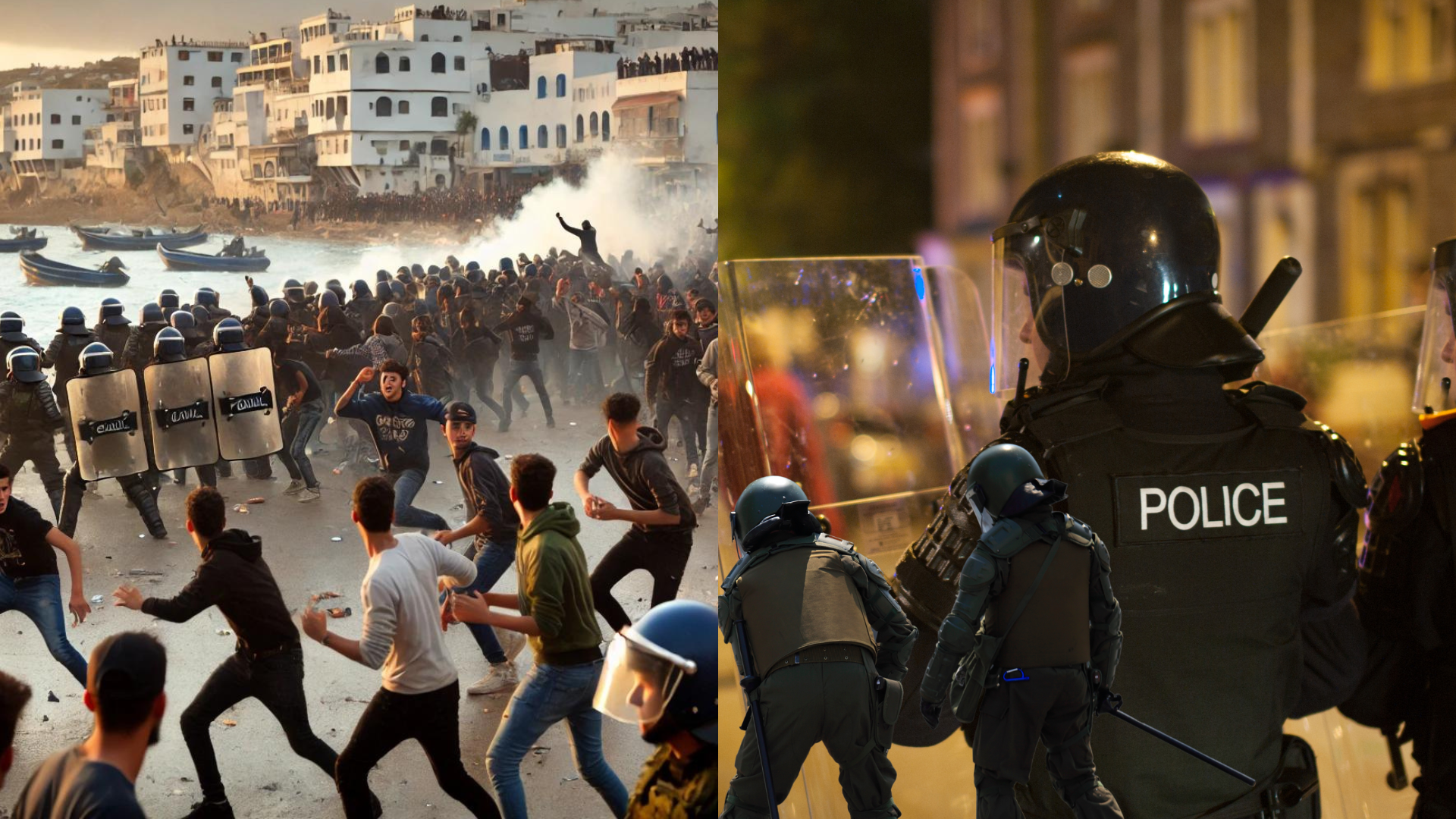
In northern Morocco, tensions have reached a boiling point as young Moroccans engage in violent clashes with police forces, driven by a growing sense of desperation over limited opportunities at home and dreams of a better life abroad. On September 22, 2024, these confrontations intensified, drawing attention to the broader social and economic challenges that have fueled discontent across the country.
Background and Catalysts
The unrest primarily centers around attempts by large groups of young Moroccans to migrate illegally to Spain. These attempts have surged dramatically in recent weeks, particularly in the northern coastal areas closest to Europe. The situation reached a critical point after a wave of social media campaigns encouraged mass illegal migration, painting the journey across the Mediterranean as an achievable goal despite the risks involved.
Morocco has long been a hub for African and Middle Eastern migration towards Europe, but recent events have highlighted a growing trend of young Moroccans themselves attempting to leave. This internal migration phenomenon is fueled by a high unemployment rate, economic stagnation, and a lack of future prospects for many young people.
Clashes and Arrests
The clashes erupted when security forces moved to disperse groups attempting to head for the coastline and catch boats for Spain. Riot police were deployed to key hotspots, particularly around Tangier and Nador, both significant departure points for migrants. During these operations, police arrested over 150 individuals who were reportedly trying to organize illegal crossings.
The clashes saw the youth hurl rocks and other projectiles at police, leading to several injuries on both sides. The authorities responded with tear gas and arrests, but the underlying tension has continued to simmer. For many of these young people, the prospect of migration is not just a desire but a perceived necessity for survival.
Economic Despair Driving Migration
Morocco, despite its relative stability in North Africa, has struggled with high youth unemployment and economic disparities, especially in its northern regions. Many young Moroccans feel left behind by the country’s economic development and see little opportunity for advancement. This economic frustration has only been exacerbated by the recent pandemic and global economic challenges, which have particularly affected sectors like tourism and manufacturing, key pillars of Morocco’s economy.
The allure of Europe, seen as a land of opportunity, has become more potent as economic prospects in Morocco dim. However, the journey across the Mediterranean is perilous. Many who attempt it face the risks of drowning, exploitation by smugglers, or being turned back by European authorities. Yet, for many young Moroccans, these dangers seem worth the risk compared to the bleak outlook at home.
Government Response
The Moroccan government, in response to this wave of migration attempts and the ensuing violence, has pledged to crack down on illegal migration networks. Officials have also urged young Moroccans to remain patient and have faith in the country’s long-term development plans. However, for many of the youth involved in these clashes, such reassurances ring hollow.
In an effort to quell the situation, the authorities have increased their presence in northern regions, but experts warn that without addressing the root causes of the unrest—primarily unemployment and economic stagnation—these efforts may only provide a temporary solution. Migration pressure, particularly among Morocco’s youth, is likely to remain a significant challenge for the foreseeable future.
The Broader Migration Context
Morocco’s role in the larger migration landscape has always been complex. As a transit country for many sub-Saharan Africans attempting to reach Europe, Morocco has, in recent years, strengthened its border controls with the support of the European Union. This has made it more difficult for non-Moroccan migrants to cross into Spain, especially via the Ceuta and Melilla enclaves.
However, the rise in Moroccan nationals themselves attempting to migrate marks a troubling new phase in this migration crisis. The government’s strategy has involved a mix of crackdowns on smugglers and increased patrols along the coastline, but this does not address the core issue: a generation of young people who feel abandoned by their own country.
Looking Forward
As northern Morocco remains a flashpoint for these tensions, it is clear that a more comprehensive strategy is needed to address the root causes of youth unrest and migration. Without significant economic reforms, investment in job creation, and efforts to engage young people in their own futures, the cycles of frustration and violence may continue.
The international community, particularly Europe, also faces a challenge in balancing its desire to curb illegal migration with the necessity of supporting economic development in countries like Morocco. Long-term solutions will likely require collaboration between Morocco and its European partners, focusing not just on border security but also on addressing the economic disparities driving migration.
For now, the streets of northern Morocco remain tense as young people continue to clash with police, risking everything in the hopes of a new life across the sea.
This escalating situation serves as a stark reminder of the ongoing struggles many nations face in balancing economic growth, migration pressures, and social stability(HESPRESS English Morocco News).
Verizon announced a sweeping workforce reduction that will affect “more than” 13,000 employees — roughly 13% of its global headcount — in what CEO Dan Schulman calls the company’s largest-ever layoff. In an internal memo, Schulman says the move is intended to “simplify our operations to address the complexity and friction that slow us down and frustrate our customers.” The company also plans to cut outsourced and outside labor costs significantly. U.S.-based staff will begin receiving notifications today; employees outside the U.S. will be informed in the “coming weeks,” the Wall Street Journal reports
What Verizon says
- Reason: operational simplification and removing friction that hurts customer experience.
- Scale: “more than” 13,000 roles, about 13% of the workforce.
- Outsourcing: a significant reduction in outsourced and outside labor spending is part of the plan.
- Timing: U.S. notifications begin immediately; international notifications will follow.
Immediate impact
- Employees: tens of thousands will be affected directly or indirectly. U.S. notifications beginning today means many workers will learn their status immediately.
- Operations: Verizon says the goal is to reduce complexity and improve service — but short-term disruption to teams and projects is possible as roles are consolidated.
- Customers: Verizon frames the change as a way to speed decision-making and improve customer experience, though execution risk exists during the transition.
- Outsourced partners: vendors and contract workers can expect renegotiation or reductions.
What affected employees should do now
- Check official communications from HR and your manager for next steps and severance details.
- Ask about outplacement support (resume help, job counseling) and whether the company offers extended healthcare, COBRA assistance, or phased transitions.
- Document your work (accomplishments, repos, access) and secure personal copies of non-sensitive materials.
- File for unemployment as soon as possible where eligible and update LinkedIn and your network.
- Use company resources (employee assistance programs, career centers) and local talent services.
What managers and the company should prioritize
- Clear, compassionate communications and FAQs for affected employees.
- Fast, transparent explanation of severance, benefits continuation, and outplacement services.
- Careful workload redistribution and project continuity plans to avoid customer impact.
- A public-facing message to reassure customers and investors about service continuity and long-term strategy.
Market and strategic context (what this implies)
- Verizon is attempting aggressive cost reduction while refocusing on product and service quality (e.g., 5G, fixed wireless, enterprise services).
- Cutting outsourced labor and internal layers can reduce costs but carries execution risk: lost institutional knowledge, lowered morale, and short-term productivity dips.
- Investors may welcome lower operating expenses; customers and regulators will watch for service degradation.
Rabat — October 2025
Inside Morocco’s Parliament, tension and reflection filled the air just hours after His Majesty King Mohammed VI delivered his opening-session speech. What was meant as a national roadmap quickly turned into a day of open confrontation, emotional testimonies, and unexpected admissions from members of both majority and opposition blocs.
🏛️ A Speech That Touched Nerves
The King’s address, described by analysts as “direct and reform-oriented,” called for greater social justice, job creation, and balanced development across Morocco’s regions.
“No village left forgotten, no coast without a hand,” the King declared — a message that resonated deeply with citizens and lawmakers alike.
Within hours, parliamentary corridors buzzed with interviews, arguments, and introspection. Some MPs hailed the speech as “a moral reset,” while others questioned whether the government was capable of turning royal vision into tangible results.
🧠 From Rabat to the Sahara — Gen Z Responds
Younger members of Parliament — labeled as جيل زد (Gen Z) — became the focus of cameras and public curiosity. Many expressed frustration at what they see as a widening gap between political promises and everyday realities faced by Moroccan youth.
“The King spoke about unity and work. We agree — but the youth need a chance to prove themselves,” said one 28-year-old deputy.
“We have the energy; the system just needs to open its doors.”
Another young MP caused a social-media storm after saying that “in some ways, Moroccan social values are stronger than Germany’s.”
Critics accused him of downplaying Europe’s economic strength, while others applauded his pride in Moroccan family cohesion.
He later clarified his words, emphasizing that every nation faces challenges — and that Morocco’s real wealth lies in its people.
💬 Resignation, Reflection, and Responsibility
Just a week earlier, one deputy had submitted his resignation in protest over what he called “a lack of listening to the new generation.”
After the King’s address, he withdrew it.
“The royal speech gave me renewed hope. This is not the time to quit — it’s time to work,” he told reporters.
Across party lines, both RNI and PAM youth wings echoed similar messages: commitment to reform, but also impatience with bureaucracy.
Several MPs criticized ministers who, they said, “do not answer calls, do not reply to written questions, and have lost touch with citizens.”
⚖️ Opposition Voices: ‘A Government in Denial’
Members of the opposition used the session to accuse the cabinet of denial and poor communication, arguing that ministers are “living in a different reality” from citizens struggling with prices and unemployment.
“The royal messages were clear,” said one opposition leader. “The problem is not the King’s vision — it’s implementation.”
🌍 Morocco’s Path Forward
Analysts note that the King’s address aligned with long-standing themes: national cohesion, balanced territorial development, and respect for dignity in public service.
But the 2025 context — economic pressure, youth disillusionment, and the digital activism of Gen Z — gives these calls new urgency.
“This generation communicates differently,” said a policy researcher. “If institutions don’t adapt, they’ll lose credibility.”
🕊️ A Message Beyond Politics
As the parliamentary session ended, one young MP summed up the mood:
“الملك تكلّم… ونحن سنُجيب بالعمل — The King spoke, and we will answer through action.”
For now, the chamber that often echoes with partisan debates found itself united — briefly — under a single message:
Morocco’s future belongs to its youth, but responsibility belongs to everyone.
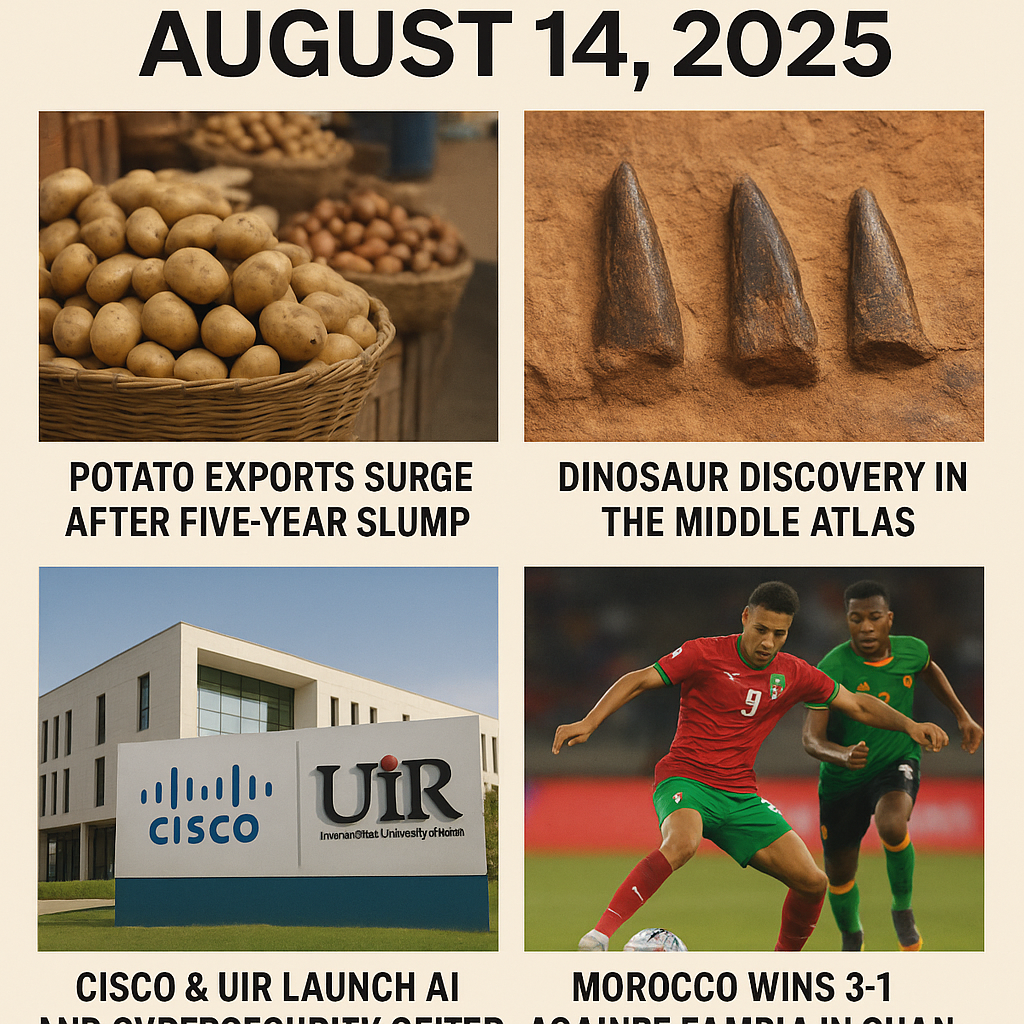
From potatoes to paleontology, Morocco posts gains across economy, science, and sport, while DV-2025 visa delays put pressure on applicants.
Morocco’s potato exports surged after a five-year slump, paleontologists uncovered the country’s oldest Turiasaurian teeth in the Middle Atlas, and UIR teamed with Cisco on a new AI & cybersecurity center. Authorities also approved the Amazigh name “Massinissa,” Morocco beat Zambia 3–1 at CHAN, and DV-2025 lottery winners sounded alarms over stalled interviews. FreshPlazaMorocco World News+3Morocco World News+3Morocco World News+3Hespress
The Briefing
Morocco’s news cycle on August 14, 2025 offered a snapshot of a country diversifying—export recovery in agri-food, frontier science with Jurassic-era finds, digital capacity-building through a new AI/cyber hub, and a culture-rights win on Amazigh naming—rounded off by a CHAN victory and visa-processing anxieties for DV-2025 winners. FreshPlazaMorocco World News+3Morocco World News+3Morocco World News+3Hespress
Economy — Potatoes Are Back
After five years of decline, Morocco’s ware-potato exports rebounded to 42,900 tons worth US$14.9 million between July 2024 and May 2025—a 5.7× increase versus the prior season. Analysts credit renewed West African trade links and firmer European demand. The uptick helps farmers and cold-chain logistics while testing resilience ahead of the 2025–26 campaign. FreshPlaza
Explainer takeaway: A stronger potato campaign increases rural incomes and stabilizes supply chains; monitoring fertilizer prices, shipping rates, and weather will indicate whether the rebound is durable.
Science — 160-Million-Year-Old Giants
Researchers identified three dinosaur teeth from the Middle Atlas (El Mers III Formation), marking the oldest evidence of Turiasauria on mainland Africa—a Middle Jurassic lineage previously best known from Iberia. The peer-reviewed study tightens biogeographic links between North Africa and Europe and invites fresh fieldwork in Boulemane province. Morocco World NewsYabiladiResearchGate
Explainer takeaway: Morocco’s Jurassic strata continue to fill global fossil gaps, boosting scientific tourism and training opportunities for local geoscience programs.
Technology — UIR × Cisco Unveil AI & Cybersecurity Center
The International University of Rabat (UIR) and Cisco signed an MoU to create a Cisco EDGE Incubation Center focused on AI and cybersecurity, aligning with Morocco’s Digital 2030 ambitions. The hub aims to link academia, startups, and public services while leveraging Cisco Networking Academy pathways. Morocco World NewsMap NewsMedafrica TimesLinkedIn
Explainer takeaway: Expect new pipelines for SOC talent, secure-cloud skills, and AI safety research—areas where Morocco seeks digital sovereignty and exportable know-how.
Society — A Win for Amazigh Naming Rights
Following an initial refusal, Meknes authorities approved the Amazigh name “Massinissa.” The reversal reflects ongoing normalization of Amazigh names in civil registry practice and reduces administrative friction for families seeking culturally rooted identities. Morocco World NewsHespressFacebook
Explainer takeaway: Documentation shapes access to education, healthcare, and travel; clearer acceptance of Amazigh names streamlines everyday life and affirms linguistic rights.
Sport — CHAN Boost: Morocco 3–1 Zambia
Morocco’s locally based national team defeated Zambia 3–1, strengthening its CHAN 2024 (played in 2025) campaign and securing a quarterfinal berth. Wins at CHAN raise player visibility, support domestic leagues, and can lift transfer valuations for homegrown talent. Hespress
Explainer takeaway: CHAN is a showcase for domestic football systems; Morocco’s result supports the broader talent pipeline from Botola clubs to continental competition.
Migration — DV-2025 Interview Delays
DV-2025 lottery winners in Morocco report stalled interview scheduling at the U.S. Consulate in Casablanca as the September 30, 2025 fiscal-year deadline nears, raising fears that selectees could time out despite “current” case numbers. Civil-society calls urge transparent scheduling and capacity updates. Morocco World News
Explainer takeaway: Diversity Visas are time-bound; absent appointments by the end of the fiscal year, eligibility ends—even for qualified selectees. Applicants should ensure DS-260s are complete and monitor consular notices.
What to Watch Next
- Agri-exports: Does the potato rally carry into Q4 logistics and pricing? FreshPlaza
- Science & tourism: Will new Middle Atlas digs expand fossil trails and museum programs? Morocco World News
- Talent & tech: Can the UIR–Cisco hub seed startups and feed national SOC capacity by 2026? Morocco World News
- Civil registry: Are further Amazigh naming cases resolved consistently across regions? Hespress
- CHAN: Injury management and fatigue as fixtures compress. Hespress
- DV-2025: Any scheduling updates from Casablanca before Sept. 30. Morocco World News


New X Feature Reveals Where Users Really Are — And It’s Already Causing Chaos

Verizon Slashes Jobs in Record-Breaking Layoff — Here’s What We Know


